Waterfalls and water curtains for a prefab pool
A waterfall or water curtain is added to a prefab pool as a separate feature next to the wall, with its own supply from the plant room. It brings sound and movement, but also more evaporation and a rise in pH.


Waterfall or water curtain
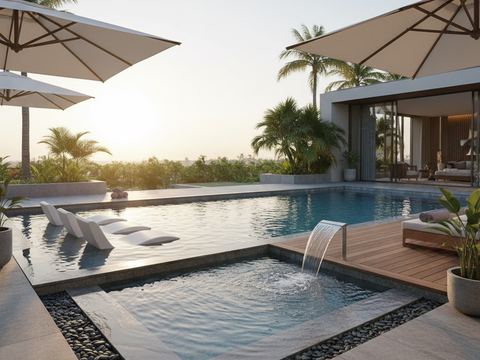
A waterfall pours water from a low wall, a rock or a stainless steel spout, with a sound like a stream. A water curtain is a thin, wide sheet of water that falls more gently, often from a wall or pergola next to the pool. The first gives you movement and sound, the second a cleaner, more architectural look.
In both cases, the pool's own water circulates: it is pumped up and falls back into the pool. No new water is added and no separate chemistry is needed, but this movement affects the water in ways worth knowing in advance.
How it is added to a prefab pool
In a prefab pool the walls are steel panels lined with the liner, so the waterfall is not supported on them. It is built as a freestanding feature at the edge or slightly back from it, and the water falls into the pool. A separate pipe runs from the plant room to it, under the paving or the garden.
- In a new pool, the pipe and the position of the waterfall are planned together with the rest of the pipework.
- In an existing pool, you usually need to cut a trench in the paving or the soil to run the line.
Whether and how it can be done for your pool is checked at the site survey: the position of the plant room, the distance, the space available and how it relates to the inlets.
Why it needs its own pump
The pool's main pump is sized to push the water through the filter. If it also feeds a waterfall, the flow is split and neither the filtration nor the waterfall works properly. That is why a waterfall usually has a separate pump, with its own switch or timer, so it only runs when you want it. It is chosen based on the height and width of the fall; see the basics of the pool pump.
What changes in the water
| Effect | Why it happens | What you do |
|---|---|---|
| pH rises | Aerating the water drives off carbon dioxide | Test more often and correct with pH− |
| More evaporation | More water surface in contact with the air | Run it only when needed |
| Temperature drops | Falling water loses heat | Switch the waterfall off when you want warm water |
| Scale on the spout | Hard water drying on the edge | Regular cleaning, checking water hardness |
The rise in pH is the most common effect, so it is worth knowing how to adjust pool pH. If the pool is heated, the waterfall works against the pool heating, so set running times that do not overlap.
Sound, wind and position
The sound of water is the reason many people want a waterfall, but you are not the only one who hears it. In a built-up area, running it late in the evening may bother the neighbours; a timer solves that. More on noise and good relations in your pool and the neighbours. Take the wind into account too: in a strong wind a water curtain scatters droplets outside the pool, and the water lost this way can look like a leak.
As for position, the waterfall is best placed opposite the skimmer or pushing the surface towards it, so it helps the cleaning instead of getting in its way. With LED lighting in the water or behind the fall, it becomes the focal point of the pool at night.
Questions
Can I add a waterfall to an existing pool?
Often yes, as long as a pipe can be run from the plant room to the waterfall, which means cutting a trench in the paving or the garden. Feasibility is checked at the site survey.
Does the waterfall need to run all day?
No. It usually runs when you are at the pool or for a few hours in the evening, on a timer, to keep evaporation, pH rise and noise down.
See also
Villa pool
A villa pool: perimeter or one-sided overflow towards the view, 3D membranes, LED lighting and the spaces…
Pool lighting
LED pool lighting: white or coloured light, how many lights and where, safety extra-low voltage and how the…

Pool pH
Pool pH: why we keep it at 7.2–7.6, how to raise or lower it with pH+ and pH−, what happens to chlorine and…