Lighting your pool: LED spotlights and the lighting around it
One or two LED spotlights on the right side are enough for most home pools. They run at safety extra-low voltage through a transformer, and the effect is completed with soft light in the surrounding area.


Why LED
Underwater LED spotlights have replaced the old halogen bulbs. They use far less power, last much longer, barely heat up and give you a choice of colour. In an older pool, switching to LED is usually done in the same position, as part of a renovation.
White or coloured light
- White: the most natural result. Warm white gives a cosy atmosphere, cool white brings out the blue of the water.
- Coloured (RGB): fixed colours or changing programmes, for evenings with friends and events. Controlled by remote, phone app or switch.
The liner colour changes the result: with a white or light blue liner the light spreads brightly, with dark grey the look is more subdued and deep. See liner colours.
How many lights and where
The number depends on the size of the pool, the brightness of the light and the liner colour. A small pool is usually lit with one spotlight, larger and long, narrow pools with two or more, spread along the length.
- The lights usually go on the side nearest the house or terrace, so they shine towards the opposite end and do not dazzle anyone looking from there.
- They are fitted below the waterline, at the depth specified by the light's manufacturer, so they are always submerged.
- On steps and benches, a small light helps the entry show up at night.
Good lighting is not just about looks. When the floor, the steps and the edges of the water are clearly visible, night-time swims are safer and the supervising adult can see better what is happening in the pool.
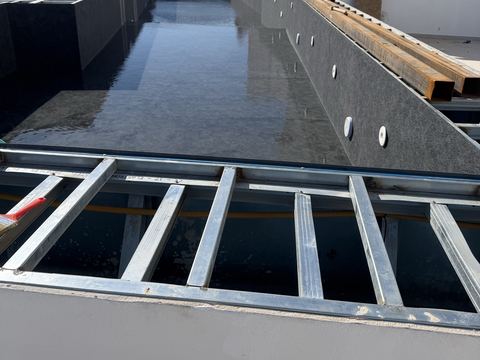
In a prefab pool the spotlight is fitted into an opening in the panel before the liner goes in. The liner is clamped around it with a flange and gasket, as with every fitting that passes through it. That is why lighting is planned from the start, together with the other fittings; the watertightness of the pool depends on these points.
Safety: extra-low voltage
Pool lights run on safety extra-low voltage, usually 12 V, supplied by a special isolating transformer. The transformer is installed outside the pool and the zone around it, usually in the plant room, and the line feeding it is protected by a residual current device (RCD).
The pool's electrical installation is carried out by a licensed electrician, in line with the regulations in force. Do not replace lights or transformers yourself, and do not use light fittings that are not made for pools.
The light around the pool
A lit pool in a dark garden seems to "float", but the area around it also needs soft light, for safety and atmosphere:
- low lights on steps and paths;
- recessed LEDs in the deck or paving, which do not dazzle;
- uplighting on one or two trees or a stone wall;
- warm light near the water, which usually attracts fewer insects than cool light.
You will find ideas for zones and paths under garden design with a pool. Garden lights are best controlled by a timer or sensor, so they are not left on all night.
Questions
Can I add lighting to an existing prefab pool?
Usually yes, but it needs an opening in the panel, a new penetration through the liner and a cable to the transformer, which means lowering the water level and a technician. There are also lights that fit into an existing return inlet; the solution is decided during the site survey.
Does LED pool lighting use a lot of electricity?
No, compared with the pump or the heating its consumption is small. An LED spotlight needs a small fraction of the power of an old halogen light, especially if it is only on when you use the pool.
See also
Garden design
Garden design with a pool: how to set out zones for swimming, loungers, shade and dining, where the paths run…
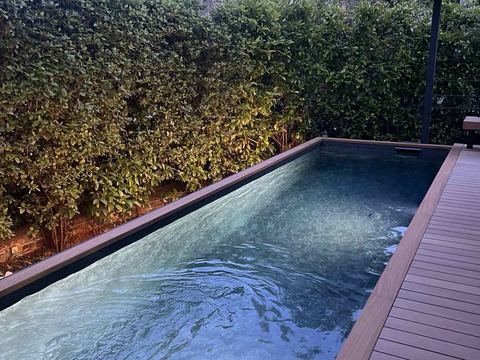
Pool deck
A pool deck in wood or composite: the differences, ventilating the substructure, maintenance, heat underfoot…
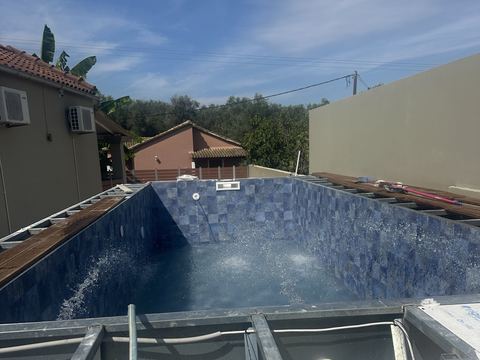
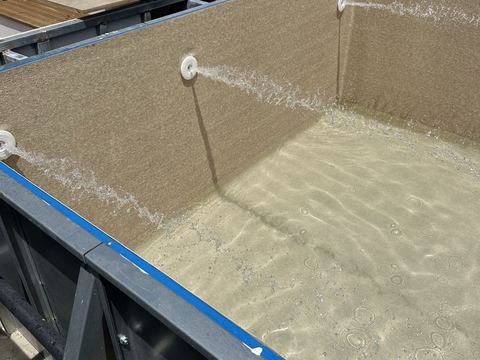
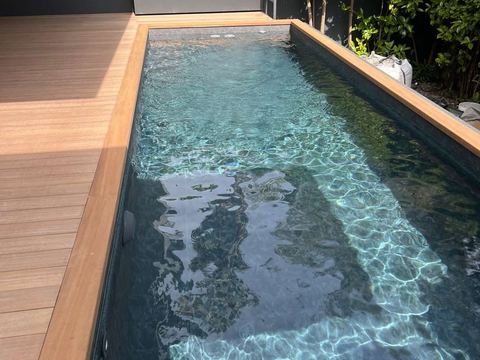
Liner colours
Pool liner colours: how white, light blue, grey, sand and green change the look of the water, its temperature…