Pool heating: the options and how to choose
Heating starts with a cover that keeps the warmth in at night. On top of that you add solar collectors, a heat pump or a heat exchanger, depending on how early in spring and how late in autumn you want to swim.


Keep the heat in first, then add more
An uncovered pool loses most of its heat through the surface, mainly by evaporation, and more so on windy nights. That is why every heating system performs much better when the pool is covered. Before choosing a heater, think about the cover: it is the simplest measure and multiplies the effect of everything else.
The options at a glance
| System | Energy source | Advantages | Limitations |
|---|---|---|---|
| Solar cover | Sun | Simple, keeps the heat in, cuts evaporation | Raises the temperature by only a few degrees, needs rolling up every day |
| Solar collectors | Sun | No electricity used for heating, simple operation | Need space on a roof or the ground, depend on sunshine |
| Heat pump | Electricity and heat from the air | Controlled temperature, good efficiency in mild weather | Needs an electricity supply, can be heard, less efficient in the cold |
| Heat exchanger | The house boiler or heating system | Makes use of an existing system | Needs pipework to the house and spare capacity |
| Electric heater | Electricity | Small, fast | High consumption, only for very small volumes |
The main systems in brief
Solar cover and collectors
A bubble solar cover floats on the water, lets a little sunlight through and, above all, stops evaporation. Pool solar collectors are black panels or grids of special plastic tubing that the pump sends the water through to warm up. Details, along with the gains from the pool's position and liner colour, are under solar pool heating.
Heat pump
It takes heat from the air and transfers it to the water, using far less electricity than the heat it delivers. It is the most common solution when you want a steady temperature regardless of sunshine. How it works, sizing and positioning are explained under pool heat pumps.
Heat exchanger
An exchanger in the pool circuit takes hot water from the house's boiler, heat pump or solar water heater without the two waters mixing. It makes sense when the house system has spare capacity and the plant room is not far away, and it is easier to design when the pool is built together with the house.
How to choose
- Volume: with 1.10 m panels the pool holds less water than one of the same size with 1.50 m panels and warms up more easily; see pool depth.
- Location: on a windswept island or in a mountain area, heat losses are greater than in a sheltered garden.
- Season: for a few weeks earlier and later, a cover and collectors are often enough. For swimming from spring until late autumn, you usually need a heat pump.
- Target temperature: every extra degree takes noticeably more energy. You will find comfortable ranges under pool water temperature.
- Space and power: a roof or ground area for collectors, a spot with free air flow for a heat pump, an adequate electricity supply.
How much longer the season gets
Without heating, an outdoor pool in southern Greece is pleasant mainly from late spring to early autumn. With a cover you gain days or even weeks at each end. With a heat pump and a cover, the season can start early in spring and last until late autumn, with energy use rising as the weather gets colder.
Heating is best discussed from the start, during the site survey, so that pipework, position and electricity supply are provided for, even if the heater is fitted later.
Questions
Can I add heating to a pool that has already been built?
Usually yes. A heat pump or collectors connect into the circuit after the filter, as long as there is a suitable position, an electricity supply and a route for the pipes.
Is heating worth it without a cover?
Hardly. Without a cover, much of the heat you add during the day is lost at night, mainly through evaporation, and the heater runs for many more hours.
See also

Heat pump
Pool heat pumps: how they take heat from the air, what COP means, how to choose the size, where the unit goes…
Solar heating
Solar pool heating: collectors, a solar cover and the gains from the pool's position, shelter from the wind…
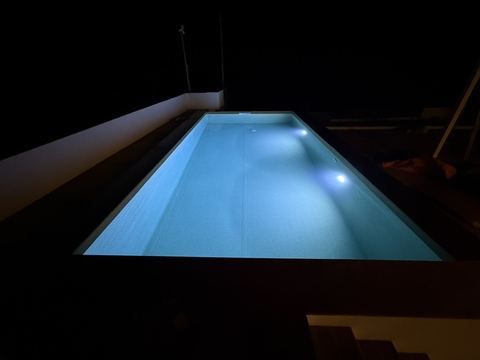
Pool cover
Solar summer covers, winter covers, roller covers and safety covers: what each does for temperature,…