Warm water from the sun: collectors, cover and the right position
The sun warms your pool in three ways: through collectors that the water flows through, with a solar cover that keeps the heat in, and through the right position and colour of the pool itself.


Solar pool collectors
Pool collectors are different from the solar water heater on a house roof. They are usually black plastic panels or grids of thin tubes, unglazed, built for high flow and a small temperature rise. The pool water passes through them and comes back slightly warmer, over and over for as long as the sun is out.
How they connect
- They take water after the filter, so they do not clog.
- A three-way valve, manual or motorized, sends the water to the collectors or bypasses them.
- In automatic installations, a controller with sensors compares the temperature of the collectors with the water and opens the valve only when the collectors are warmer. That way the pool is not cooled in the late afternoon.
- If the collectors are high up, e.g. on a roof, it is checked whether the pump has the necessary head or whether a separate pump is needed.
How much area and where
As a rule of thumb, the collector area is usually between half and roughly the same as the water surface, depending on sunshine, exposure to wind and how much you want to extend the season. They are installed facing south and free of shade, on a roof, pergola, slope or the ground. Before winter they are drained so that water does not freeze inside them.
The solar cover
A bubble cover floats on the surface. It lets part of the sun's radiation through, but above all it cuts evaporation, the biggest "thief" of heat in an uncovered pool. In a pool that stays covered when not in use, the difference is noticeable within a few days. With a roller reel at the edge, you take it off and put it back in a few minutes. You will find the types and precautions under pool covers.
Passive gains: position, wind, colour, depth
Before any equipment comes in, part of the heating is decided at the design stage:
| Factor | What helps |
|---|---|
| Position | Sun from morning to afternoon, away from tall trees and walls that cast shade |
| Wind | Shelter from the prevailing wind with a fence, plants or a wall |
| Liner colour | Dark colours absorb slightly more radiation than light ones |
| Depth | With 1.10 m panels there is less water to heat |
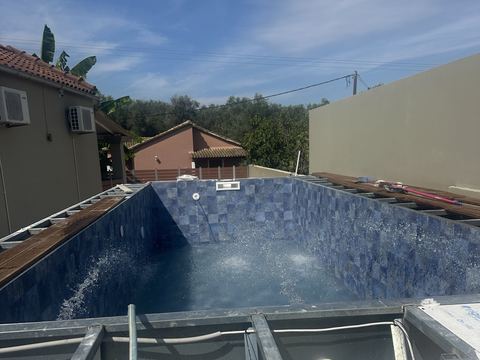
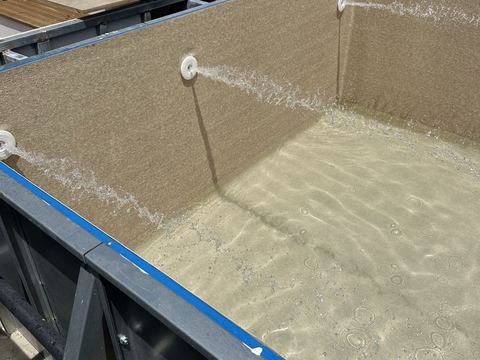
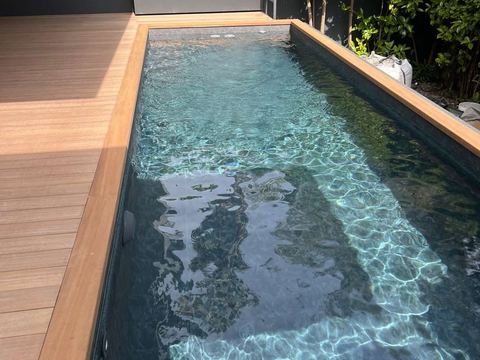
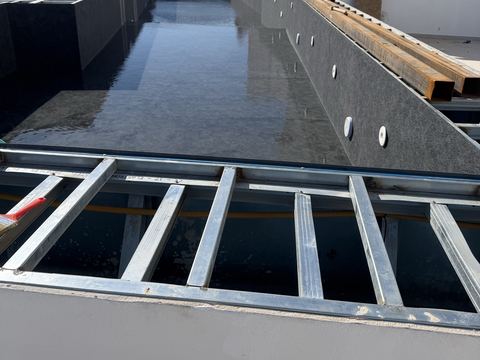
Position is covered in detail under where to put the pool in your garden, and the effect of colour under liner colours. A dark liner is not a heating system; it gives a small advantage, which shows mainly when the pool is covered.
What to expect realistically
Solar heating extends the season by a few weeks at each end and makes the water more pleasant on cool summer mornings. It cannot guarantee a specific temperature on cloudy days or in winter. People who want a consistent result often combine collectors with a heat pump: the sun does the heavy lifting on good days and the heat pump tops up when needed. The combinations for your pool are discussed during the site survey.
In high summer the opposite happens: the collectors can push the water temperature higher than is pleasant. Then the valve is closed or the controller is set with a maximum temperature, and the cover stays off for some hours. Some controllers can also cool the water by sending it through the collectors at night.
Questions
Do solar collectors change the water chemistry?
No, they just warm the water. But warmer water uses up chlorine slightly faster and encourages algae, so test pH and chlorine more often.
How much does a solar cover raise the temperature?
It depends on the weather, the wind and how many hours it stays on. Its big benefit is that it stops the water cooling down at night, so the day's heat builds up from one day to the next.
See also

Pool heating
Heating a prefab pool: solar cover, solar collectors, heat pump, heat exchanger. What suits your pool volume,…
Pool cover
Solar summer covers, winter covers, roller covers and safety covers: what each does for temperature,…
Liner colours
Pool liner colours: how white, light blue, grey, sand and green change the look of the water, its temperature…