Filling the pool for the first time, step by step
The first fill decides how the liner settles and how easily the water can be balanced. You choose a source, check its quality, fill without interruptions and do the chemical balancing in the right order.


How much water you need
The volume is length × width × average water depth. A 4 × 8 m pool with a water depth of around 1.40 m needs about 45 m³, which is about 45 tonnes of water. Keep this number handy: you will need it for every chemical dose from now on.
With a garden hose, a fill like this often takes more than 24 hours, depending on mains pressure. That is why it is scheduled together with the installation crew, so the pool is not left half full.
Where the water comes from
| Source | Advantages | What to watch |
|---|---|---|
| Mains water supply | Clean water of known quality | Filling time; possible municipal restrictions in summer, especially on the islands |
| Water tanker truck | Fast filling, in a few hours | Ask for drinking water from a clean tank; the truck must be able to get fairly close to the pool |
| Borehole | Quantity and independence | Analysis before filling for metals, hardness and salt |
If you fill from a borehole
Borehole water can look crystal clear and still contain iron, manganese or copper. As soon as chlorine goes in, the metals oxidize, the water takes on a brownish or greenish tint and it can leave stains on the liner. A laboratory analysis before filling shows whether you need a metal sequestrant or pre-filtration. With boreholes near the sea, also check the salinity, and hard water needs scale prevention (see water hardness).
How the liner settles
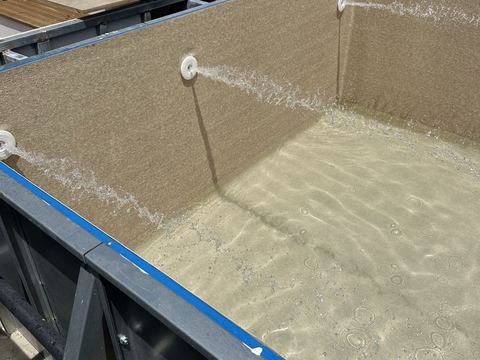
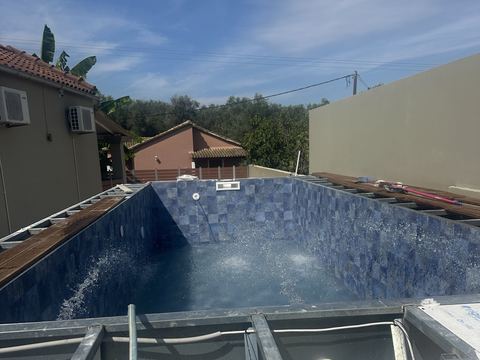
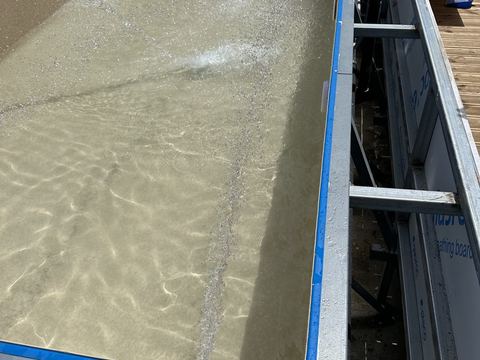
During installation, the air between the liner and the walls is removed by suction so the membrane takes on the exact shape of the pool. Filling starts while the suction is still running. The small folds in the floor are smoothed out in the first few centimetres of water, because later the weight of the water "locks" them in place.
- Do not step into the pool with shoes on, and do not let sharp objects touch the liner.
- Do not stop filling halfway for days; the liner must stretch evenly.
- The openings for the skimmer, return inlets and lighting are cut when the water reaches just below them, so the gaskets and face plates go on with the liner taut.
- Filling continues to about the middle of the skimmer mouth, or to the level set by the overflow.
If you see folds after filling, do not pull at them yourself; let whoever installed the liner know. Causes and prevention are covered in wrinkles in the liner.
The first chemical balancing
With the pool full, backwash and rinse the filter to clear the dust from the new filter media, and let the pump run continuously for the first 24 hours. Then follow this order:
- Test all the parameters; testing the right way matters from day one.
- If the water is from a borehole with metals, add a metal sequestrant first.
- Correct the total alkalinity.
- Bring the pH to 7.2–7.6.
- Do the initial chlorination so free chlorine settles at 1–3 mg/l.
Add each product separately, with the pump running, and test again before the next one. In the first few weeks, test more often, because new water often needs a few corrections before it is balanced.
Never put chlorine granules directly onto a new liner. Dissolve them in a bucket of water and pour the solution near the return inlets. And remember that a liner pool, once filled, is never completely emptied.
Questions
Can we swim as soon as the pool is full?
Better not before the first chemical balancing and before the water has passed through the filter. Once pH and free chlorine are within their ranges, the pool is ready.
Our borehole water turned brown as soon as we added chlorine. What should we do?
The chlorine has oxidized the metals in the water. Add a metal sequestrant as directed on the pack, let the filter run continuously and backwash when the pressure rises; if the water has not cleared within a few days, get an analysis and technical help before stains form.
See also

Step-by-step construction
Prefab pool construction step by step: site survey, paperwork, excavation, panels, pipework, liner and…
Water testing
Testing pool water properly: strips, DPD drops or a photometer, how to take a sample, what to test, how often…

Water hardness
Pool water hardness: what calcium does, why scale forms at the waterline, what to expect on islands and with…