Liner pools: why they stay full and how the water is refreshed
In a liner pool the water is not just for swimming: its weight keeps the membrane stretched against the walls and the floor. When fresh water is needed, we do a partial water change, not a full drain.


What happens to the liner without water
The liner is cut and fitted to match the exact shape of the pool, and the water presses it evenly outwards. If the pool is emptied, that pressure is lost and the problems begin:
- It shrinks. PVC contracts, especially in the cold. When the pool is refilled, the membrane may not sit properly again or may pull away from its fixings at the edge.
- It dries out in the sun. A membrane left exposed to the air and sun loses some of its elasticity.
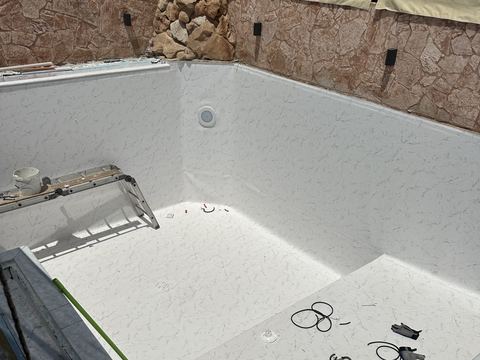
- It wrinkles. When the pool is refilled, the folds often stay for good. More in wrinkles in the liner.
- It is at risk from groundwater. Where the water table is high, or after a lot of rain, the water in the ground pushes the floor up from below. With a full pool the weight of the water balances that pressure; with an empty one, the liner can balloon and shift.
The result can be an early liner replacement, which nobody wants for a simple water change. That is why the rule is fixed: a liner pool is never emptied completely, neither for cleaning nor for the winter.
When fresh water is needed
With proper maintenance the water lasts for many years. Some substances, however, build up and cannot be removed with chemicals, only by dilution:
- the chlorine stabilizer has risen so high that the chlorine no longer works well,
- the hardness is very high and leaves scale at the waterline,
- the water needs more and more chemicals to stay clean, even though the filter and circulation are working properly.
Partial water change step by step
- Test. Knowing what you want to correct tells you roughly how much water needs replacing.
- Lower the level by a few tens of centimetres, using the valve's “Waste” position or a submersible pump. For more than that, ask your technician first.
- Watch where the water goes. It must end up at a drain point, not on a neighbouring plot or in the street. If you want to use it for watering, let the chlorine drop first.
- Refill straight away. If the water comes from a borehole, you need to know its hardness and metal content, as we explain in filling a pool.
- Adjust and repeat. Let the circulation run, test again and, if needed, do one more round a few days later.
Many small steps are safer than one big one. Besides, every backwash and every rainy winter already replaces part of the water without you noticing.
And if draining is unavoidable?
There are cases, such as fitting a new liner or a repair under the floor, where the pool has to be emptied. Then the job is done by a technician, in suitable weather, with a check for groundwater and with the pool left empty for as short a time as possible. Do not attempt it yourself.
When closing for winter, the water level is simply lowered below the skimmers. See the steps in closing your pool for winter.
Questions
How much water can I safely remove in one water change?
For a simple refresh, a few tens of centimetres at a time is enough, with refilling immediately afterwards. If you need to go lower, ask your technician first, especially if the plot has groundwater.
If the liner is being replaced anyway, does it matter how long the pool stays empty?
Yes, because in an empty pool the floor or the base can also be affected by groundwater and the weather. The pool is emptied in a controlled way shortly before the new liner is fitted, on the schedule the technician sets.
See also

Winterizing
Winterizing your pool: active or passive winterizing, chemistry, water level, pipework, floats, cover, and…
Liner wrinkles
Pool liner wrinkles: how water chemistry, groundwater and draining cause them, what a reinforced membrane…
Chlorine stabilizer
Chlorine stabilizer (cyanuric acid): how it protects chlorine from the sun, what level to aim for, what…