Steel panels: the frame of a prefab pool
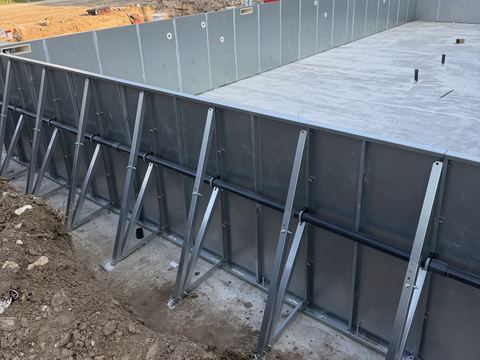
Steel panels are the ready-made walls of a prefab pool: sheets of 2 mm galvanized steel that are bolted together, anchored to the base and supported from behind by hot-dip galvanized buttresses.


What the panels do and what the liner does
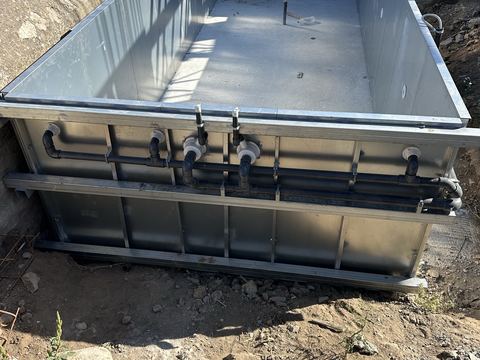
In a prefab pool, the walls are not built on site. They are formed from ready-made galvanized steel panels, which arrive on site piece by piece and are joined into one continuous wall. The PVC liner then lines the inside. The roles are clearly split: the panels give shape and strength, the liner makes it watertight.
The panels are 1.10 m or 1.50 m high, and this sets the depth of the pool. Which height suits which use is explained in the article on pool depth.
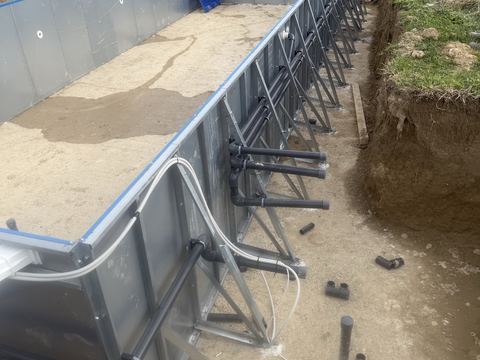
How they are fixed: anchors, bolts, buttresses
| Component | Specification | Role |
|---|---|---|
| Panel | 2 mm galvanized steel, 1.10 or 1.50 m high | Forms the wall |
| Panel anchoring | 4 expansion anchors 12/15 on each panel | Holds the panel firmly on the base |
| Panel joints | M8×2.5 galvanized bolts | Ties each panel to the next one |
| Support buttress | 4 mm steel, hot-dip galvanized | Supports the wall from the outside |
| Buttress anchoring | 2 anchors and an adjuster | Stabilizes the buttress and keeps the panels vertical |
The buttress adjuster matters more than it seems. A panel that leans even slightly inwards or outwards shows later in the waterline and in how the liner sits. With the adjuster, the walls are levelled one by one while everything is still accessible.
The assembly sequence
- A level base is prepared to the dimensions of the pool.
- The panels are set up in sequence and bolted together.
- They are anchored to the base, the buttresses go in and the walls are checked for plumb.
- The skimmer or channel, return inlets, lighting and pipework are fitted.
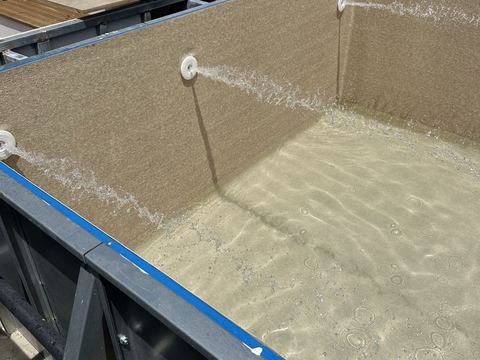
- The liner goes in, the pool is filled and the area around it is finished.
The full process, from the site survey to filling, is described in building a prefab pool step by step.
Protection from corrosion
The steel is protected by galvanizing, a layer of zinc that takes the brunt of the moisture first. On the buttresses the galvanizing is hot-dip: the finished part is dipped in molten zinc, so the edges and holes are covered too. The bolts are galvanized as well, so there is no weak point at the joints.
The panels sit behind the liner, so they do not come into contact with the chlorinated water. What must be avoided is rainwater collecting around the walls. That is why the falls in the paving around the pool and the drainage of the garden matter.
Do not drill or cut the panels to fix something on afterwards, such as a light or a railing. Any such change should first be discussed with the builder.
What to ask for in writing
The frame cannot be seen after construction, so it is worth knowing in advance exactly what will go in. Ask for these to be stated:
- the material and thickness of the panels,
- how the buttresses are galvanized,
- the number and type of anchors,
- the type of bolts at the joints.
More questions for comparing builders are in how to choose a pool builder.
Steel or polyester
As well as steel panels, there are also polyester panels. When each one is considered is covered in polyester pool panels. With either frame, the pool can have a skimmer or an overflow channel.
Questions
Do steel panels rust in the ground?
The steel is galvanized and the buttresses are hot-dip galvanized, so they withstand moisture in the ground. It helps a lot if rainwater does not collect around the pool.
Can the panels get through a narrow passage?
Yes. They are carried one at a time, so they fit through doors, corridors and stairways and are easy to load onto a ship for the islands. See also a pool in an existing garden.
See also

Polyester panels
Polyester pool panels: what they are, which ground conditions call for them and how they compare with the…
Pool lifespan
How many years a prefab pool lasts: what the frame withstands, when the liner is renewed, what wears out the…
Step-by-step construction
Prefab pool construction step by step: site survey, paperwork, excavation, panels, pipework, liner and…