How to keep children safe at the pool: measures that work together
No single measure is enough on its own. Children's safety at the pool rests on layers: constant supervision when they swim, physical barriers when they don't, and children who know how to get out of the water.


Supervision: the layer nothing replaces
Drowning is usually silent and fast. A child in difficulty rarely shouts or splashes about the way they do in films. That is why, when children are in or near the water:
- appoint one adult each time as the “water watcher”, who looks at the pool and not at their phone;
- when they step away, even briefly, they explicitly hand over to another adult;
- young children and those who do not swim well stay within arm's reach;
- armbands and inflatables do not replace supervision.
At parties and gatherings the risk increases, because everyone assumes someone else is watching.
Barriers for when nobody is swimming
The risk is not limited to swimming time. A small child can reach the pool at a moment when nobody expects it.
Fencing
A fence around the pool, with a self-closing, self-latching gate and a latch placed high, out of children's reach, is one of the most effective measures. It must have no footholds and no garden furniture right up against it. Materials and options in our article on pool fencing.
Safety cover
A cover designed for safety and properly secured prevents falls into the water. A simple bubble solar cover is not a safety cover: a child can slip underneath it. You will find the differences in pool covers.
Alarm
There are alarms that react when something falls into the water, alarms for the fence gate or the house door, and wristbands that the child wears. They are a useful extra layer, not a substitute for fencing or supervision. We discuss the options at the site survey.
The pool itself
- Getting in and out: steps or a pool ladder with handrails, so a child can easily find the way out.
- Non-slip surfaces: on steps and benches, membranes with a class C non-slip surface, such as SOPREMAPOOL 3D and Feeling.
- Depth: with 1.10 m panels the pool is friendlier for young children. A home pool is never for head-first diving.
- Outlets: the covers of the suction outlets must be in place and intact, and children should not play near them.
- Chemicals: locked away, away from the water and from children. See safe chemical storage.
Rules and skills
- No running around the pool.
- No head-first diving.
- Nobody swims alone, not even adults.
- Toys come out of the water after swimming, so they do not draw little ones to the edge.
Swimming lessons, and above all practising how to get out of your own pool, reduce the risk. It is also worth the adults in the household taking a first aid and CPR course.
If the pool is used by guests at holiday accommodation, additional obligations may apply. Your engineer and the competent authorities confirm them.
Questions
Is a safety cover enough without a fence?
It helps a lot, but it only protects when it has been put on correctly every time. A fence with a self-closing gate protects even when someone forgets the cover, which is why the two measures are combined.
At what age can a child swim without supervision?
There is no age that makes it safe in a private pool, because even good swimmers can get hurt or tired. The rule “nobody swims alone” applies to everyone.
See also
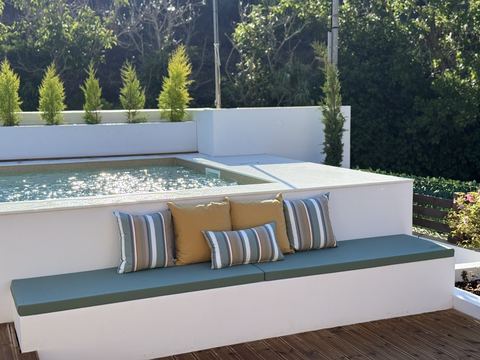
Pool fencing
Pool fencing: glass, metal or wood, a height and gaps a child cannot climb, a self-closing gate, and how to…
Pool cover
Solar summer covers, winter covers, roller covers and safety covers: what each does for temperature,…

Family pool
A family pool for 4–6 people: what size you need, why a 1.10 m depth is preferred, where the steps go and how…