Secure footing in the pool: anti-slip membranes
Most slips inside a pool happen on the steps and the bench. A membrane with a Class C anti-slip texture gives secure footing with bare, wet feet.


Where people slip in a pool
A standard liner is smooth: pleasant to the touch, but with water, sunscreen and the thin film of slime that forms on surfaces, it becomes slippery exactly where you put your full weight. The critical spots are:
- the built-in steps, especially the first one below the surface, where your foot lands without a clear view;
- the bench, where you sit, stand up and push off with your hands;
- the floor in front of the steps, where children stand and play;
- the moment you get in, stepping in with wet feet from the paving.
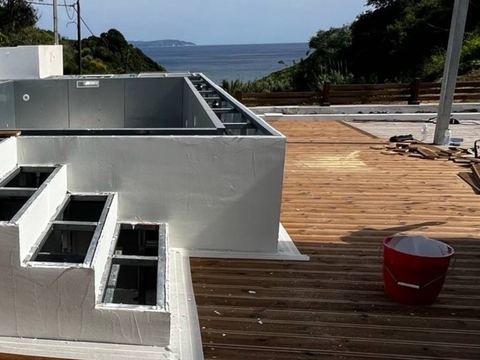
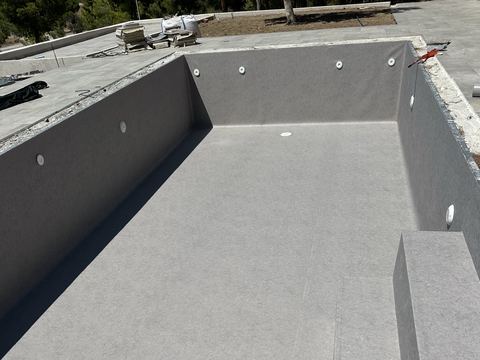
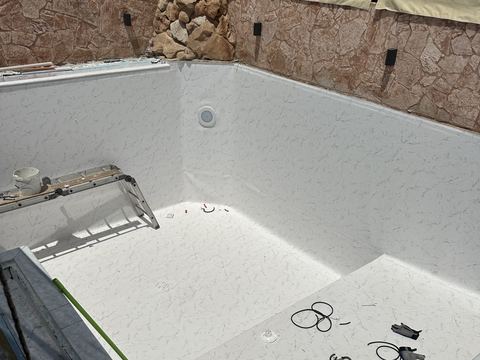
In a prefab pool, the built-in steps and the bench are covered with membrane, just like the rest of the pool. That is an advantage: with an anti-slip membrane, the grip is a property of the surface itself, not an adhesive strip that peels off or wears away over time.
What Class C means
The slip resistance of surfaces walked on barefoot in wet areas is graded into Classes A, B and C, with C being the most demanding. SOPREMAPOOL 3D and SOPREMAPOOL Feeling membranes have Class C slip resistance according to EN 13451-1 and DIN 51097.
| Membrane | Thickness | Surface | Slip resistance |
|---|---|---|---|
| PVC liner with internal reinforcement | 1.5 mm | Smooth, solid colour or mosaic | Standard, not anti-slip |
| SOPREMAPOOL Feeling | 1.5 mm | Solid colour, textured to the touch | Class C |
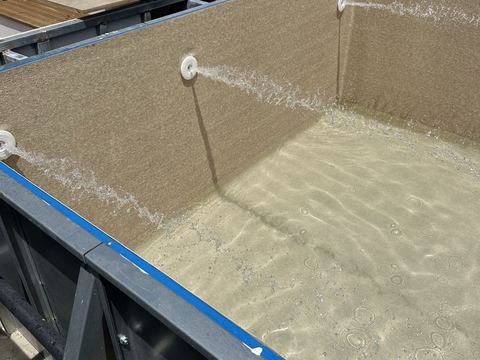
| SOPREMAPOOL 3D | 1.8 mm | Three-dimensional texture reminiscent of natural materials | Class C |
Both SOPREMAPOOL membranes have a lacquer that resists UV radiation and chlorine, and both are hot-air welded, as we explain in reinforced PVC membrane. Whether the whole pool is lined with anti-slip membrane or only the areas you step on, and in which colour, is decided at the site survey.
Who it makes a difference for
- Young children, who run, constantly get in and out, and stand on the steps to play.
- Older people and anyone with balance problems, for whom a slip can have serious consequences.
- Guests at holiday accommodation, who don't know the pool and often get in covered in sunscreen.
- People who exercise in the water or do rehabilitation exercises, where footing must be stable.
For families, see the other measures in pool safety for children. For commercial use, where durability and safety matter even more, see pools for small hotels.
What else you need besides the surface
The membrane is part of the solution, not all of it. Also check:
- A handrail on the built-in steps, or a stainless steel ladder with wide treads; the options are in pool ladders.
- The paving outside the water: many slips happen at the edge and on the way to the shower; see paving around the pool.
- Lighting that shows the steps clearly in the evening.
- Regular brushing: body oils, sunscreen and dust slowly fill the texture and reduce grip.
In short, an anti-slip membrane does not replace supervision and rules, but it removes one of the most common causes of minor accidents.
Questions
Is an anti-slip surface easy to clean?
It needs a little more care than a smooth one, because the texture holds on to oils and dust. A gentle weekly brushing of the steps and bench, with a brush suitable for liners, is usually enough.
Do I need an anti-slip membrane if the pool has a stainless steel ladder?
The ladder has its own treads, so the need is smaller. But if the pool has a bench or built-in steps, the membrane surface matters more there.
See also
Pool ladder
Pool ladders: a stainless steel ladder, built-in steps or a bench. Where the entry goes, grab rails and an…

Child safety
Pool safety for children in layers: supervision, fencing, a safety cover, alarms, rules and swimming lessons.…
Reinforced PVC membrane
Reinforced PVC pool membrane: what the reinforcement does, how it is hot-air welded on site, and how it…